
In a rapidly evolving job market, one European innovation is quietly revolutionising how we describe, understand, and validate professional competencies. Meet ESCO—the comprehensive skills classification system.
Picture a recent graduate from a Danish technical college applying for engineering positions across Europe. Her digital credentials don’t just state she completed “Industrial Automation Systems”—they map her competencies to standardised European classifications, instantly showing employers in Barcelona, Berlin, or Budapest exactly which skills she possesses and how they align with specific job requirements.
This level of granular skills intelligence represents a fundamental shift towards a competency-based career development.
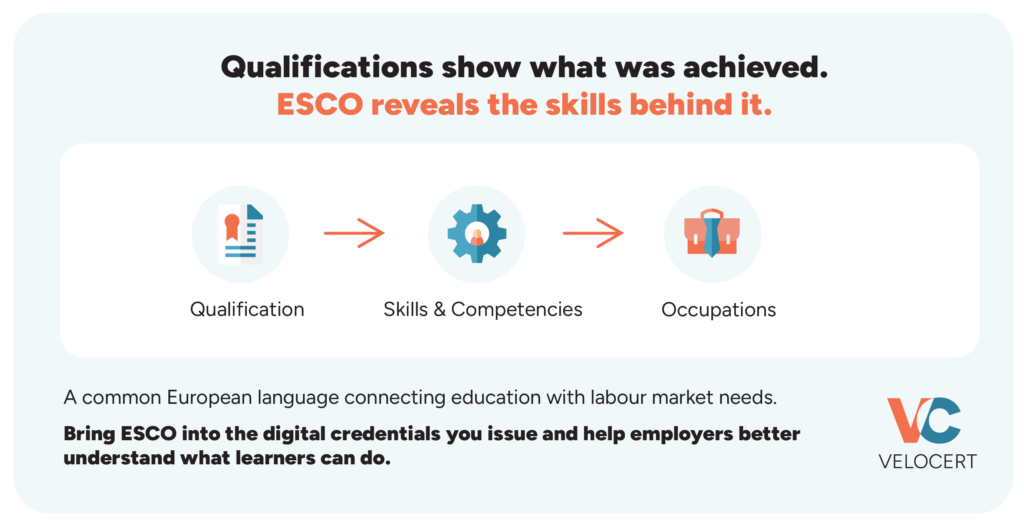
The Skills Taxonomy Revolution
Traditional educational credentials have long suffered from a critical limitation: they tell employers where someone studied and what they studied, but provide minimal insight into what they can actually do. A degree in “Computer Science” from one institution might emphasise theoretical algorithms, whilst the same degree title elsewhere focuses on practical software development.
This ambiguity creates significant challenges across European labour markets:
- Skills Mismatches: Employers struggle to understand what qualifications actually represent in terms of practical capabilities, leading to poor hiring decisions and unfulfilled job requirements.
- Career Mobility Barriers: Professionals find it difficult to articulate their transferable skills when moving between industries, countries, or career paths.
- Education-Industry Gaps: Educational institutions lack precise feedback about which competencies employers actually need, resulting in graduates unprepared for modern workplace demands.
- Cross-Border Recognition: Skills and qualifications described using different national frameworks resist easy comparison and recognition across European borders.
The European Skills, Competences, Qualifications and Occupations (ESCO) classification addresses these challenges by providing the first comprehensive, multilingual taxonomy of skills, competences, and occupations used across the European Union.❶
Understanding ESCO: Europe’s Skills DNA
ESCO represents far more than a simple list of job titles or skills. It’s a sophisticated, interconnected classification system that maps the complex relationships between occupations, skills, and qualifications across all sectors of the European economy.
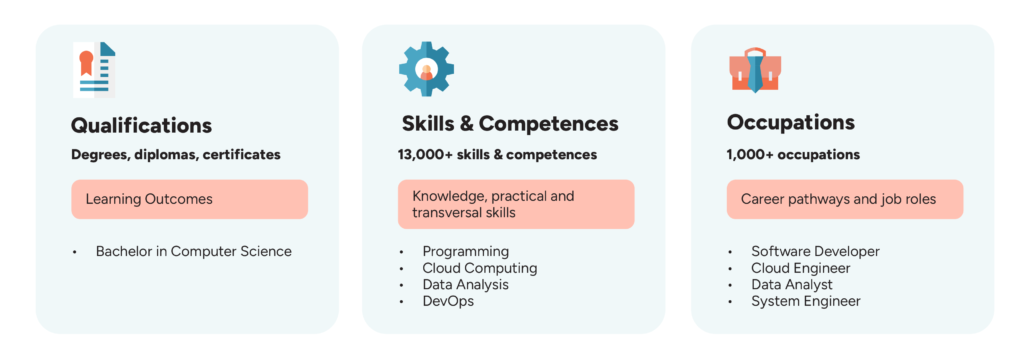
The system comprises three interconnected pillars:
Occupations Pillar
Structured descriptions of approximately 1,000 occupations across all economic sectors, organised according to international standards. Each occupation includes task descriptions, essential and optional skills, career pathway connections, and links to relevant educational programmes.
Skills and Competences Pillar
More than 13,000 skills and competences forming one of Europe’s most comprehensive classifications of professional capabilities. These include knowledge areas (theoretical understanding), skills (practical abilities used to perform tasks and solve problems), competences (the proven ability to apply knowledge and skills to achieve specific outcomes), and transversal skills such as critical thinking, communication, and digital literacy that are valuable across multiple sectors.
Qualifications Pillar
Connections between educational achievements and occupational requirements, including formal qualifications awarded by recognised institutions, professional certifications and licences, and associated learning outcomes. This helps translate educational attainment into skills and competences that are relevant to the labour market.
ESCO’s Multilingual Achievement
Available in all 27 EU official languages plus Icelandic, Norwegian, and Arabic, ESCO ensures semantic consistency across different linguistic and cultural contexts.❷ This multilingual capability enables cross-border mobility for professionals, international recruitment using multiple languages, educational alignment regardless of stakeholder languages, and policy coordination based on consistent European skills data.
Transforming Digital Credentials Through Skills Intelligence
When integrated with digital credentialing systems, ESCO transforms static certificates into dynamic, intelligent documents that provide unprecedented insights into professional capabilities:
1. Granular Competency Mapping
Traditional credentials might state someone completed “Project Management Training.”
ESCO-enhanced credentials provide specific details:
- Knowledge Competencies: Understanding of project lifecycle methodologies, risk assessment frameworks, and stakeholder management principles.
- Skills Demonstration: Proven ability to develop project schedules, manage budgets, coordinate team activities, and implement quality assurance processes.
- Practical Applications: Experience with specific tools, methodologies, and industry contexts relevant to different project types.
- Transferable Elements: Identification of competencies valuable across different industries and role types.
2. Intelligent Career Guidance
ESCO’s occupation and skills relationships can enable sophisticated career guidance:
- Skills Gap Analysis: Identification of specific competencies needed to transition between current qualifications and target occupations.
- Learning Pathway Recommendations: Suggestion of training programmes and experiences that build required capabilities efficiently.
- Career Progression Mapping: Visualisation of potential career development routes based on existing and acquirable skills.
- Market Intelligence: Real-time analysis of skills demand trends and emerging competency requirements across different sectors.
3. Enhanced Employer Matching
For employers seeking specific capabilities, ESCO-enhanced credentials provide powerful search and matching functionality:
- Precise Requirements: Job descriptions can specify exact ESCO competencies rather than relying on vague qualification requirements.
- Automatic Matching: Recruitment systems can automatically identify candidates whose demonstrated competencies align with specific role requirements.
- Skills-Based Hiring: Recruitment focus shifts from educational pedigree to demonstrated capabilities, opening opportunities for non-traditional backgrounds.
- Competency Verification: Integration with digital credential verification systems ensures claimed skills are backed by verifiable educational experiences.
The Competitive Advantage of ESCO Integration
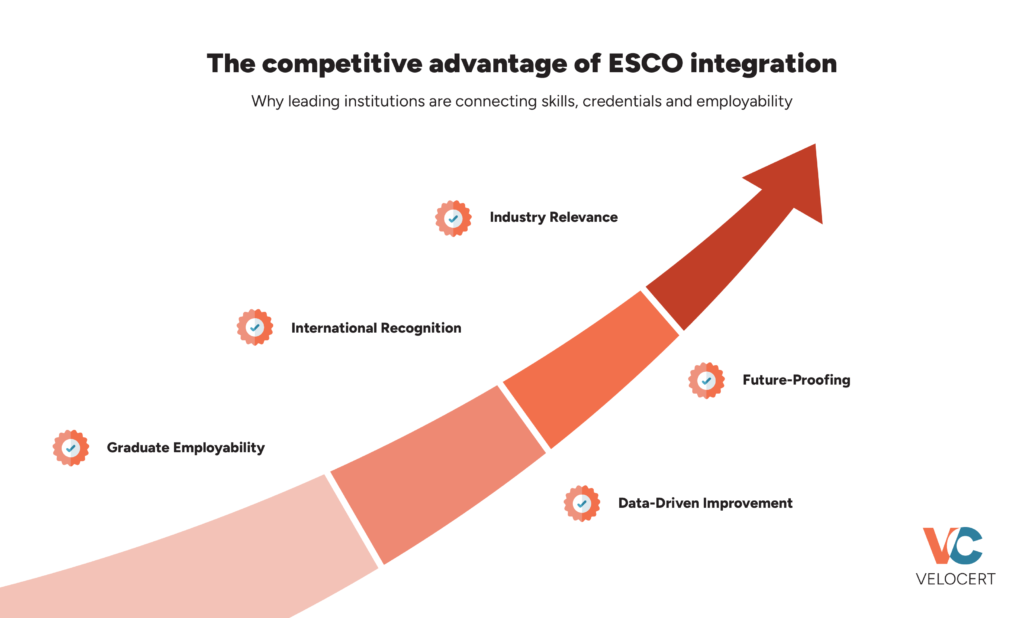
Educational institutions embracing ESCO classification gain significant advantages:
Industry relevance: Curriculum design based on real workforce needs ensures programme effectiveness and prepares graduates for the demands of the modern workplace.
International recognition: Programmes aligned with European skills standards gain greater credibility and recognition across EU Member States, supporting student mobility and institutional partnerships.
Graduate employability: Students can demonstrate specific, employer-recognised competencies rather than relying solely on generic qualifications, improving job placement prospects and career outcomes.
Future-proofing: Integrating skills frameworks positions institutions advantageously as skills-based hiring becomes increasingly common across European labour markets.
Data-driven improvement: Systematic competency tracking enables evidence-based programme enhancement and informed strategic planning to address future workforce needs.
ESCO integration represents alignment with the future of European workforce development. The systematic classification of skills creates opportunities for more precise education-industry collaboration, better career guidance, and enhanced graduate outcomes.