
In an age where credential fraud costs European businesses millions annually, one cryptographic innovation stands between authentic qualifications and sophisticated forgeries. Welcome to the world of eIDAS electronic seals—the invisible guardians of digital credential integrity.
Consider this scenario: A cybersecurity expert applies for a senior role at a major bank in Frankfurt. Her credentials look impressive—degrees from prestigious universities, professional certifications from leading technology companies, and specialist training certificates. But in today’s digital world, how can the hiring manager be absolutely certain these credentials are genuine and haven’t been tampered with?
The answer lies in a legal and technical framework that’s transforming how Europe approaches digital document authentication. Electronic seals aren’t just fancy digital signatures—they’re legally recognised, cryptographically secured stamps of approval that carry the same weight as traditional institutional seals across all 27 EU member states.
The Trust Crisis in Digital Credentialing
The digitalisation of education and professional certification has created unprecedented opportunities for both learners and institutions. However, it has also opened new avenues for credential fraud and document manipulation. Unlike physical certificates with their watermarks, special papers, and embossed seals, digital documents can be easily modified using standard software tools.
Traditional digital approaches have attempted to address these concerns with varying degrees of success:
- Basic PDF Security: Password protection and form restrictions provide minimal security against determined fraudsters with readily available editing tools.
- Digital Signatures: Personal digital signatures verify individual identity but don’t necessarily validate institutional authority or document integrity over time.
- Blockchain Solutions: While offering enhanced security through distributed verification, many blockchain approaches lack legal recognition and standardisation across European jurisdictions.
- Proprietary Systems: Platform-specific solutions often create vendor lock-in and may not provide long-term accessibility or legal certainty.
None of these approaches provide the combination of legal recognition, technical security, and cross-border validity that European institutions require for truly trusted digital credentialing.
What Are Electronic Seals?
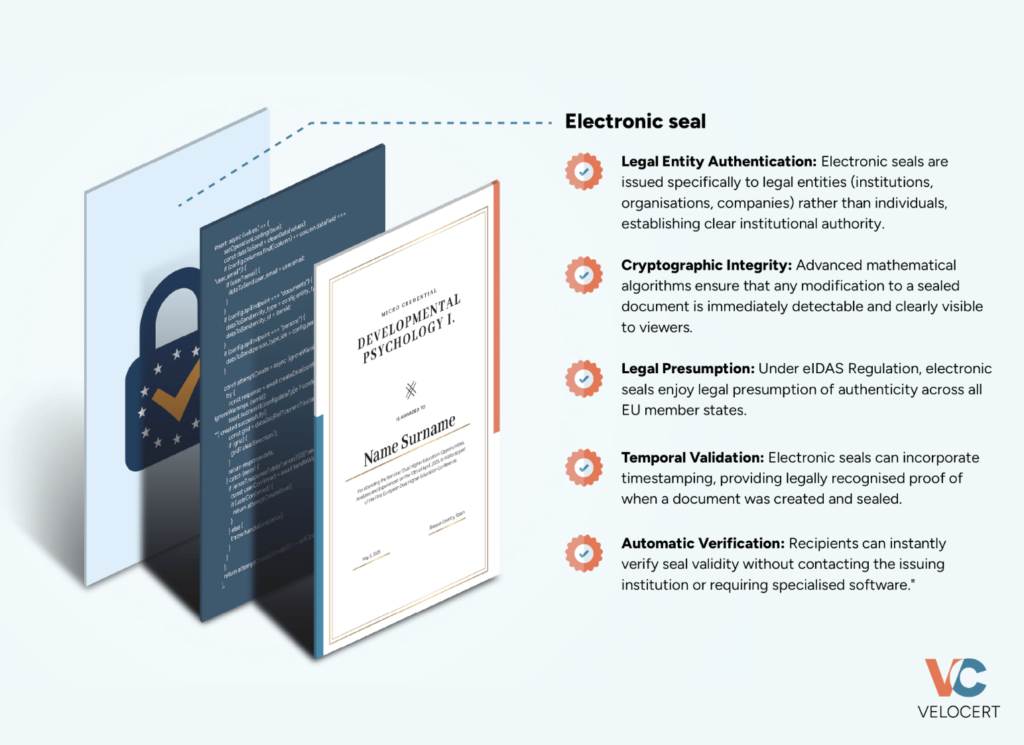
Electronic seals represent the digital evolution of traditional institutional stamps and seals. Just as a university’s physical seal validates the authenticity of a paper diploma, an electronic seal provides cryptographic proof that a digital document originates from a verified legal entity and hasn’t been altered since creation.
However, electronic seals go far beyond their physical predecessors in both capability and legal standing:
The eIDAS Framework: Europe’s Digital Trust Infrastructure
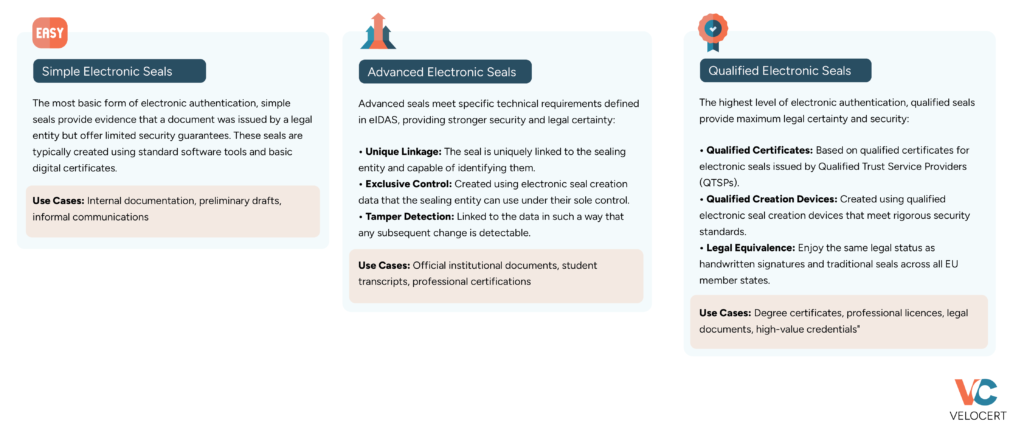
The eIDAS Regulation (EU) No 910/2014 establishes the legal framework for electronic identification and trust services across Europe, creating a unified approach to digital authentication that transcends national boundaries.❶ This regulation defines three levels of electronic seals, each with increasing levels of trust and legal recognition:
Qualified Trust Service Providers: The Foundation of Trust
The eIDAS framework establishes Qualified Trust Service Providers (QTSPs) as Europe’s certified guardians of digital trust. These rigorously assessed organisations issue and manage electronic certificates under strict regulatory supervision, accepting legal liability for their services and maintaining the highest security standards. ❷
QTSPs handle the complete certificate lifecycle—from identity verification and secure issuance using tamper-resistant hardware, to ongoing monitoring and long-term archival for legal compliance.
Transforming Institutional Operations
Electronic seals provide educational institutions with powerful operational advantages:
- Enhanced Security: Cryptographic complexity makes forgery practically impossible, whilst tamper detection triggers immediate visual warnings during verification.
- Operational Efficiency: Instant global verification eliminates manual checking processes, reducing administrative burden and enabling graduates to pursue opportunities more quickly.
- Competitive Edge: Cutting-edge security technology demonstrates institutional innovation, facilitating collaboration with technologically sophisticated partners whilst future-proofing against evolving digital standards.
Electronic seals represent more than security upgrades—they’re investments in institutional reputation and European educational leadership, providing the mathematical certainty and legal recognition that modern digital credentials require.
***
Ready to implement the gold standard of credential security? Velocert integrates eIDAS-compliant electronic seals as a core feature of its platform, providing your institution with qualified trust services and seamless seal management whilst ensuring every credential carries the full legal weight of European digital authentication standards.