Every day graduates applying for jobs or educational opportunities face the same frustrating challenge: proving their qualifications to employers and institutions across borders, and doing so fast. But the solution isn’t just going digital—it’s choosing the right digital approach.
The scenario: A recruitment manager in Amsterdam receives 200 international applications for a senior position that requires a due diligence process. Of the 10 top candidates, half present traditional paper certificates issued across various countries. The other half share various digital credentials: from simple PDFs to European Digital Credentials. Who passes the due diligence process and gets interviewed first?
This real-world scenario highlights a critical decision facing European educational institutions today: not only whether to digitise credentials, but how to choose the right digital credentialing approach that actually serves students, job applicants, employers, and institutions effectively.
The Traditional Certificate Challenge
For centuries, educational institutions have relied on paper-based credentialing systems that served their time well. These traditional certificates feature familiar elements: institutional letterheads, official seals, authorised signatures, and security features like watermarks or special paper stock.
However, traditional certificates present significant limitations in today’s interconnected world:
- Verification Delays: Confirming authenticity requires contacting issuing institutions, often taking weeks or months for international qualifications.
- Security Vulnerabilities: Despite security features, paper certificates remain susceptible to sophisticated forgery techniques.
- Physical Limitations: Paper certificates can be lost, damaged, or destroyed. Natural disasters, house moves, or simple misplacement can eliminate years of educational achievement documentation.
- Translation Barriers: International recognition often requires certified translations, adding time, cost, and complexity to cross-border mobility.
- Limited Information: Traditional certificates provide minimal detail about actual learning achievements, assessment methods, or specific competencies. These are often provided via additional documentation.
The Digital Credential Revolution
The digital transformation of credentialing has produced various solutions, each with distinct characteristics and capabilities. Understanding these differences is crucial for institutions considering their digital strategy.
Basic Digital Formats
Many institutions have transitioned to simple digital formats like PDFs or image files. Whilst these eliminate physical storage concerns, they inherit most traditional certificate limitations whilst adding new vulnerabilities, for example:
- PDF Certificates: Easy to create but equally easy to manipulate. Standard PDF editing tools can modify content, grades, or institutional details without obvious detection.
- Blockchain-Based Credentials: These offer enhanced security through distributed ledger technology but often lack standardisation and may not carry legal recognition across different jurisdictions.
The European Digital Credentials Advantage
European Digital Credentials for Learning (EDCs) represent a fundamentally different approach to digital credentialing. Built specifically for the European context, EDCs combine advanced security, legal recognition, and rich educational data in a standardised format.
Key Differentiators: Why EDCs Lead the Field
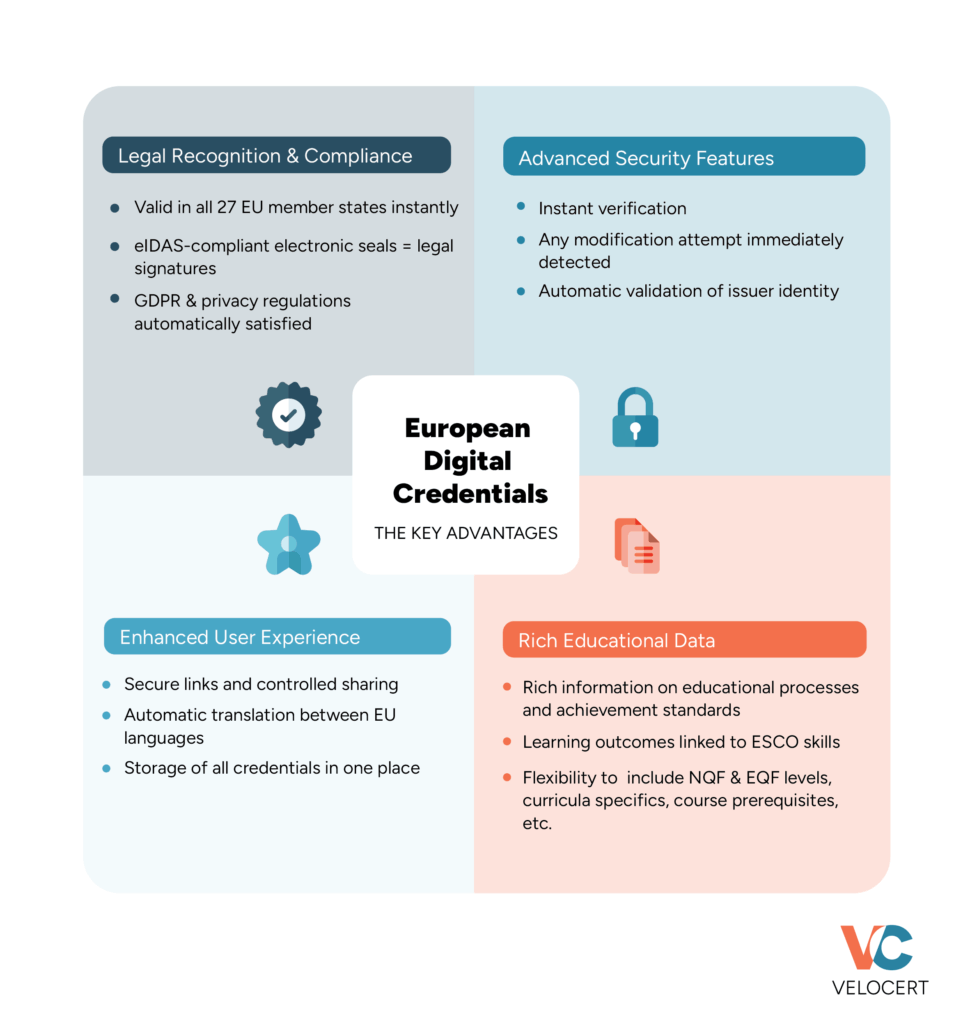
Legal Recognition and Compliance
Unlike generic digital formats, EDCs are built on the eIDAS Regulation framework, ensuring legal equivalence to traditional paper certificates across all EU member states.¹ This legal foundation provides:
- Automatic Cross-Border Recognition: EDCs issued in one EU country are automatically recognised in all others.
- Legal Presumption of Authenticity: Electronic seals applied to EDCs carry legal weight equivalent to handwritten signatures and official stamps.
Advanced Security Features
EDCs incorporate sophisticated security measures that surpass both traditional and basic digital approaches:
- Tamper-Evidence Technology: Any attempt to modify an EDC’s content triggers detection, clearly visible to anyone viewing the credential.
- Cryptographic Verification: Each EDC contains cryptographic proofs that automatically verify the issuing institution’s identity and the credential’s integrity.
- Real-Time Validation: Unlike traditional certificates requiring manual verification, EDCs provide instant authentication through automated checking systems.
Rich Educational Data
Traditional certificates provide minimal information about actual learning achievements. EDCs leverage the European Learning Model to capture comprehensive educational data:
- Detailed Learning Outcomes: Specific competencies and skills acquired, linked to recognised frameworks like ESCO.
- Assessment Information: Methods used to evaluate learning, providing context about achievement standards and rigour.
- Institutional Accreditation: Real-time verification of the issuing institution’s accreditation status and programme approval.
- Course Context: Detailed information about curricula, prerequisites, and learning pathways.
Enhanced User Experience
EDCs prioritise user experience for both issuers and recipients:
- Instant Sharing: Recipients can share credentials through secure, customisable links that expire on chosen dates or after specific view counts.
- Multilingual Support: Inbuilt translation capabilities ensure EDCs can be understood across language barriers.
- Portfolio Integration: EDCs can be stored in digital wallets alongside other credentials, creating comprehensive professional portfolios.
Real-World Impact: Transforming Educational Workflows
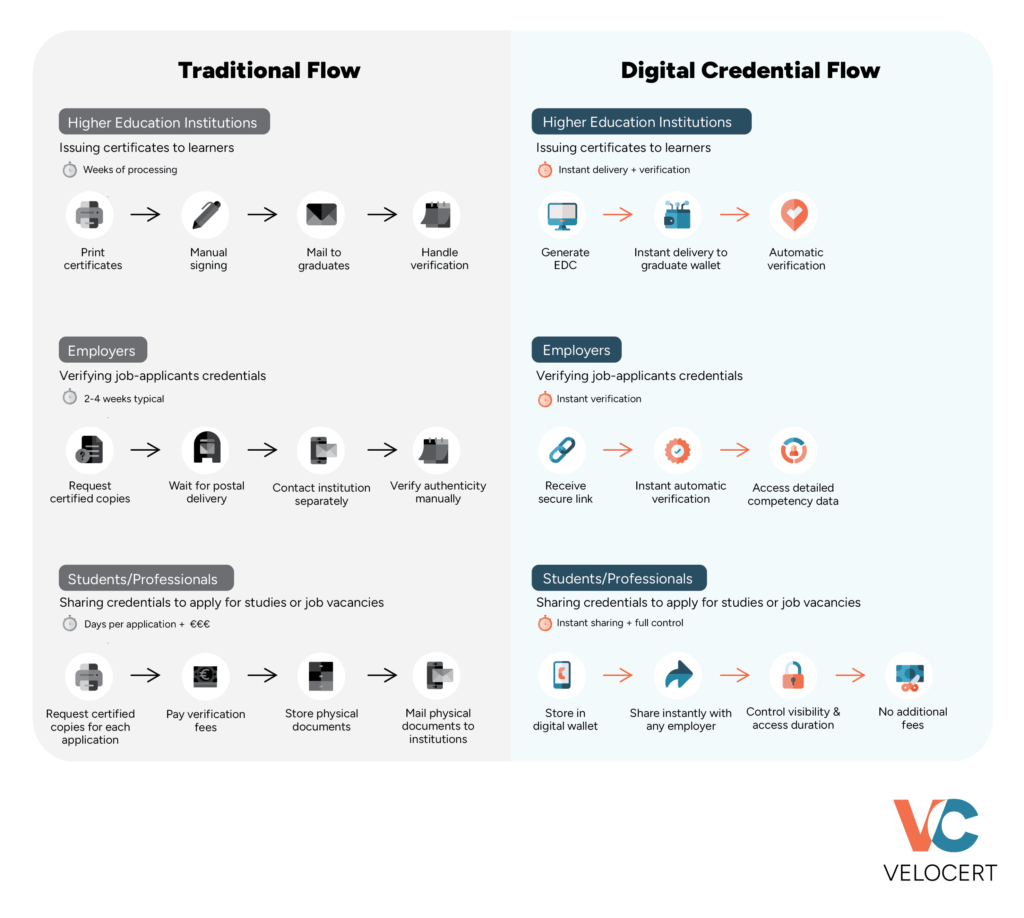
The differences between traditional and digital approaches become clear when examining practical applications:
The Economic Argument
The financial benefits of EDCs extend beyond simple cost savings:
- Reduced Administrative Costs: Automated verification eliminates manual processing, reducing staffing requirements and operational expenses.
- Faster Processing: Instant verification accelerates hiring and academic admission processes, reducing time-to-value for all stakeholders.
- Enhanced Security ROI: Prevention of credential fraud protects institutional reputation and reduces legal risks associated with false qualifications.
- Improved Graduate Outcomes: Faster verification and enhanced credential portability improve graduate employment prospects, supporting institutional success metrics.
Addressing Implementation Concerns
Common concerns about transitioning to EDCs often stem from misconceptions about complexity and compatibility:
“Will employers accept digital credentials?”
European employers are increasingly demanding faster, more reliable verification methods. EDCs’ legal recognition ensures acceptance whilst providing superior verification capabilities.
“What about international recognition?”
EDCs are built on W3C Verifiable Credentials standards, ensuring international interoperability. The EU actively promotes global adoption of these standards through international partnerships.
“Are our existing systems compatible?”
Modern EDC platforms provide API integration capabilities that connect with existing student information systems, enabling seamless adoption without wholesale system replacement.
Making the Transition
Successful EDC adoption requires careful planning and the right implementation partner. Key considerations include:
- Technical Integration: Ensuring seamless connection with existing institutional systems and workflows.
- Staff Training: Preparing teams for new processes and technologies.
- Graduate Communication: Explaining benefits and addressing concerns about digital credential adoption.
- Compliance Management: Maintaining adherence to evolving European regulations and standards.
Beyond the Hype: Making Smart Credentialing Choices
Success depends on choosing an approach that balances innovation with practicality, security with usability, and technical sophistication with institutional needs.
EDCs represent the culmination of European collaborative efforts to create a credentialing system that genuinely serves all stakeholders.
The institutions making this transition now are discovering that the right digital credentialing approach doesn’t just solve current problems—it opens new possibilities for student success, operational efficiency, and institutional reputation.
Discover how Velocert transforms institutional credentialing with comprehensive EDC solutions designed specifically for European educational institutions. Our platform combines regulatory expertise with practical implementation support, ensuring your transition to digital credentialing enhances rather than complicates your operations.