Home / Articles / Why Microcredentials Are Becoming the New Currency for Skills Providers
Why Microcredentials Are Becoming the New Currency for Skills Providers
31 January 2026
The skills market has changed, for good
The skills market has changed in a very practical way. Faster innovation cycles and shifting job roles mean that skills become outdated more quickly than before. On average, a professional skill remains relevant for around five years, often less in technical fields. The idea that one qualification can last an entire career no longer reflects reality. Continuous learning is now part of how work evolves.
This shift puts non-formal and informal education providers in a strong position. Training academies, VET providers, professional institutes, certification bodies, and specialist training organisations are built for speed and relevance. You can respond quickly to market needs and deliver focused, up-to-date learning that people actually need now.
The recognition gap: when skills don’t travel
But there is a catch.
In a global, mobile labour market, skills that are hard to verify quickly lose visibility. This is a structural challenge many providers face. Learning outcomes are issued in different formats, shaped by local systems and institutional practices. While this often works within familiar contexts, it becomes a limitation once learners move across organisations or borders.
Take Sarah, who completes a cybersecurity risk management course at your organisation and applies for a role abroad. The employer or HR team sees the certificate, but key questions remain unanswered: what exactly did she learn, how long did the programme last, at what level, and how can this be verified without a series of emails?
In that moment, the differentiator is not the course itself, but how well the institution enables Sarah to present and prove her skills. Providers that solve this gap position themselves as modern, market-aware organisations that understand how learning connects to real-world opportunities.
This is where microcredentials come into play.
What is a microcredential, really?
The term is used in many different ways, so clarity matters. A microcredential is a short, focused unit of learning that certifies specific skills or competences acquired over a defined period of time. Its purpose is simple: to clearly show what a learner knows and can do.
Universities and other formal institutions increasingly offer microcredentials, sometimes linked to accredited programmes or credit systems such as ECTS, depending on national rules. But you do not need to be a university to do this. As an informal or non-formal provider, you can also offer your teaching in a microcredential format. Your courses may not be accredited, and that is fine. Microcredentials are not only about accreditation. They are about recognition.
When issued in a structured and transparent way, microcredentials allow learning outcomes to be understood beyond the issuing organisation, even outside formal education frameworks.
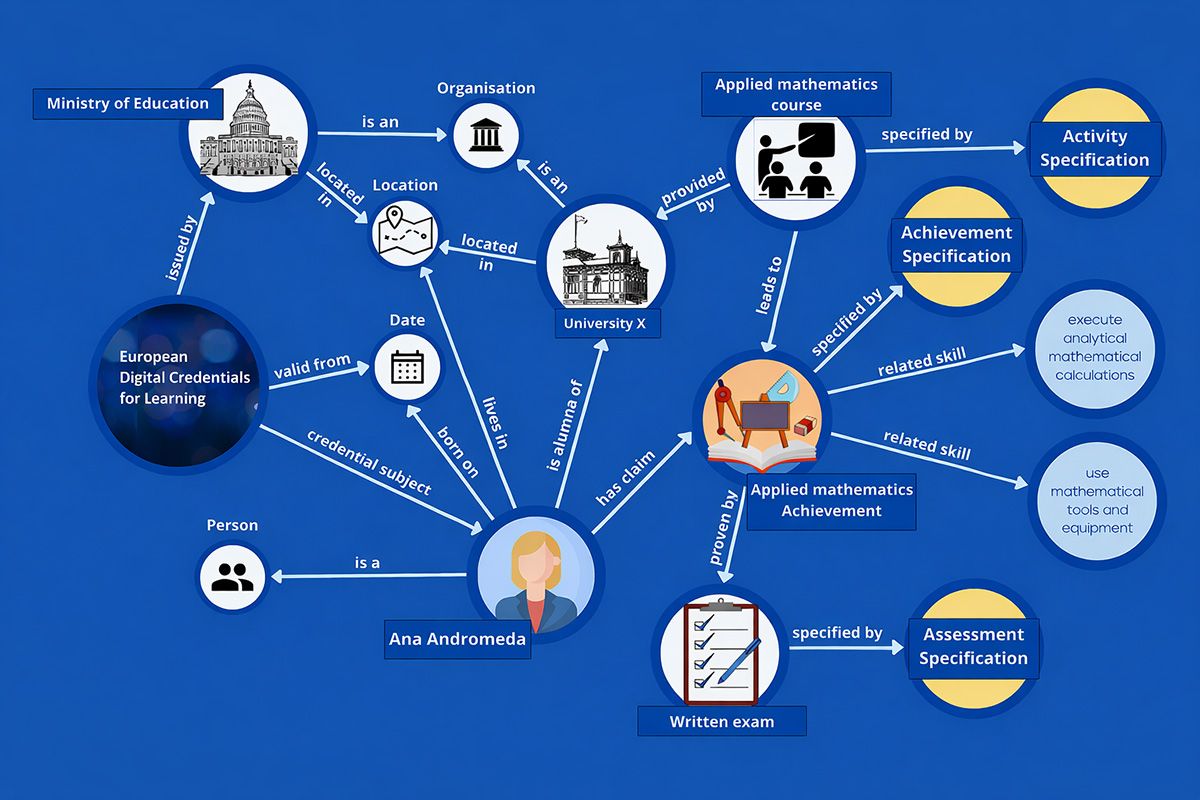
What makes this work in practice is structure and verifiability. Clearly defined learning outcomes explain the value of the learning, while digital verifiability makes it possible to confirm who issued the credential and that it has not been altered. At the European level, common models such as the European Learning Model (ELM) provide a shared way to describe learning so it can be more easily understood and compared across borders over time.
European Learning Model (ELM)
Why this is your competitive edge
Formal institutions and universities play a key role in education, but they operate within longer accreditation and approval cycles. Informal providers work differently. You move faster, adapt content quickly, and teach skills that are needed now. The challenge has never been the quality of your programmes, but how clearly their value is recognised beyond your own organisation.
By structuring your courses as microcredentials and issuing them in a format the wider market can understand, you turn relevant learning into usable proof. Issued as verifiable credentials and aligned with European approaches to skills description, your programmes become easier to compare, easier to trust, and easier to use across organisations and borders.
For learners, this means credentials that are:
Instantly verifiable, without manual checks or follow-up emails
Machine-readable, usable across digital systems such as Europass and emerging HR tools
Stackable, allowing skills to build over time into a coherent learning and career path
For institutions, this means clearer positioning, stronger credibility, and a more attractive offer for learners who care about how their skills translate into real opportunities.
Turning learning into usable proof
Velocert supports this shift by providing the infrastructure to issue structured, verifiable microcredentials aligned with European standards, without locking providers into a proprietary ecosystem.
In a market where learning is abundant but trust is uneven, the ability to issue credentials that work beyond PDFs is no longer a nice-to-have. It is what sets modern, forward-looking skills providers apart.
The question is no longer whether informal education matters. It clearly does. The question is whether your credentials are ready to travel with your learners.
The question is no longer whether informal education matters. It clearly does.
The question is whether your credentials are ready to travel with your learners.
See our pricing to see what plan works best for you. Discover how Velocert can help you reward learners, help them showcase their earned skills, and increase your reach.
We use our own cookies as well as third-party cookies on our website to enhance your experience, analyze our traffic, and for security and marketing. Select "Accept" to allow them to be used.
Functional
Always active
The technical storage or access is strictly necessary for the legitimate purpose of enabling the use of a specific service explicitly requested by the subscriber or user, or for the sole purpose of carrying out the transmission of a communication over an electronic communications network.
Preferences
The technical storage or access is necessary for the legitimate purpose of storing preferences that are not requested by the subscriber or user.
Statistics
The technical storage or access that is used exclusively for statistical purposes.The technical storage or access that is used exclusively for anonymous statistical purposes. Without a subpoena, voluntary compliance on the part of your Internet Service Provider, or additional records from a third party, information stored or retrieved for this purpose alone cannot usually be used to identify you.
Marketing
The technical storage or access is required to create user profiles to send advertising, or to track the user on a website or across several websites for similar marketing purposes.

 Take Sarah, who completes a cybersecurity risk management course at your organisation and applies for a role abroad. The employer or HR team sees the certificate, but key questions remain unanswered: what exactly did she learn, how long did the programme last, at what level, and how can this be verified without a series of emails?
In that moment, the differentiator is not the course itself, but how well the institution enables Sarah to present and prove her skills. Providers that solve this gap position themselves as modern, market-aware organisations that understand how learning connects to real-world opportunities.
This is where microcredentials come into play.
Take Sarah, who completes a cybersecurity risk management course at your organisation and applies for a role abroad. The employer or HR team sees the certificate, but key questions remain unanswered: what exactly did she learn, how long did the programme last, at what level, and how can this be verified without a series of emails?
In that moment, the differentiator is not the course itself, but how well the institution enables Sarah to present and prove her skills. Providers that solve this gap position themselves as modern, market-aware organisations that understand how learning connects to real-world opportunities.
This is where microcredentials come into play.