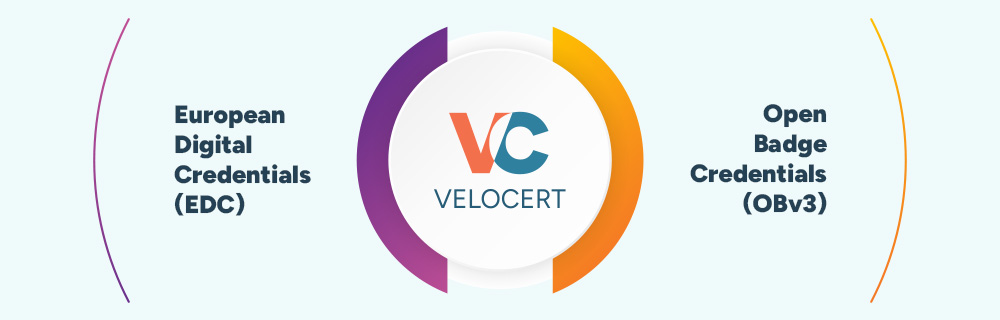
Today, we are announcing the Velocert Globally Interoperable Micro-credential —a commitment to ensuring your educational achievements work anywhere, regardless of regional standards or software stacks.
The Problem: Credentials in a Vacuum
From a user’s perspective, digital credentials today are often dead ends. You earn a hard-won certification only to find it is locked into a specific software ecosystem or a proprietary platform. If you want to move that “proof” across borders—for example, from a global platform using Open Badges to a European employer looking for European Digital Credentials (EDC)—the digital connection often breaks.
In practice, this means credentials are effectively not portable. Your achievements only “live” as long as you stay within the specific technical silo of the issuer.
It is our mission to make issuance easier for issuers and simple for holders and verifiers. You shouldn’t need to care about the technical formats of your credentials; they should just work.
Technical Interoperability by Design
We have built a service that issues micro-credentials simultaneously in both Open Badges v3 and EDC formats from a single builder. Achieving this has required:
– Metadata Alignment: We align core data—like learning outcomes, workload, and assessment criteria—so the credential carries the same weight in both formats.
– Dual Signing: Our engine generates both a JSON Web Signature (JWS) for Open Badges and a compliant signature for EDC at the point of issuance.
– API-Readiness: While we are still finalizing the integration into our main web dashboard for users, our core infrastructure, specifications, and APIs are live and ready to be tested by developers.
By bridging the gap between the European Learning Model (ELM) and global W3C/Open Badges standards, we ensure that a learner’s achievements are portable by default. Whether a credential is being verified in a European Europass profile or a global digital wallet, the data remains consistent, secure, and verifiable.
The Next Frontier: JAdES-Signed Open Badges
We are pushing this interoperability further by integrating JSON Advanced Electronic Signatures (JAdES)—the standard for eIDAS-compliant signatures—directly into the Open Badges ecosystem. This allows for the use of e-seals, which are electronic signatures issued to legal entities (organisations) rather than individuals.
By adopting JAdES-compliant e-seals, we unlock three critical benefits:
– Legal Organisational Identity: An e-seal provides a high level of certainty regarding the origin and integrity of the credential, proving it was officially issued by the institution.
– Long-term Legal Validity: It leverages the multi-decade trust infrastructure of eIDAS, ensuring credentials remain legally verifiable even if the issuing platform’s internal keys change.
– Cross-Border Recognition: E-seals are legally recognised across the EU and globally, bridging the gap between flexible global badges and strict European legal requirements for institutional proof.
Get Involved
We have published our technical specification as an RFC (Request for Comments). Our goal is to move this toward formal standardisation, but we need the community’s expertise to get there.
The APIs are open for testing, and the specs are ready for review. We are looking for feedback from developers, credential issuers, and policy experts to ensure this path forward is robust and practical for real-world use.
– Review the RFC: JWS Signature Specification (JAdES & OB v3)
– Contribute: Join the discussion on GitHub and help us turn this RFC into a global standard for interoperability.