The way we prove what we know is changing.
Not because education suddenly evolved, but because the environment around it did. Roles shift faster, industries reshape continuously, and a qualification from a few years ago often no longer reflects what someone can actually do today.
We are moving away from completed programmes toward demonstrated competencies. For organisations, this creates a very practical question: how do you understand, trust and use this information efficiently?
There is a lot of data, but not a lot of trust
Most organisations already handle some form of “digital” credentials. PDFs, platform-generated certificates, confirmations sent by email.
But these are digital in format only. In practice, they remain tied to the system that issued them, difficult to verify independently, and not designed to move across organisations or countries.
The issue is therefore no longer whether credentials exist, but whether they can be trusted, reused and applied without friction.
An EU approach that connects skills with real-world use
To address this, the EU has introduced a clear direction through European Digital Credentials (EDC). The goal is simple: make skills easier to understand, prove and use across education systems, labour markets and borders.
Micro-credentials define what a credential needs to communicate so that it can be understood anywhere: who issued it, what someone knows, how this was assessed, under what conditions. This creates a shared structure that others can rely on.
EDC defines how this information is issued and shared. As digitally signed, verifiable credentials that belong to the individual and can be checked instantly, regardless of where they are used.
This connects the full ecosystem:
- organisations issue credentials
- individuals hold and share them
- employers and institutions verify them
This is already operational. Europass wallets are live. Credentials are designed to work across systems.
Interoperability is expected, not optional. The infrastructure is in place.
Where do you stand today?
The question is how well your current approach holds up in a more connected environment.
A few practical questions can help clarify your position:
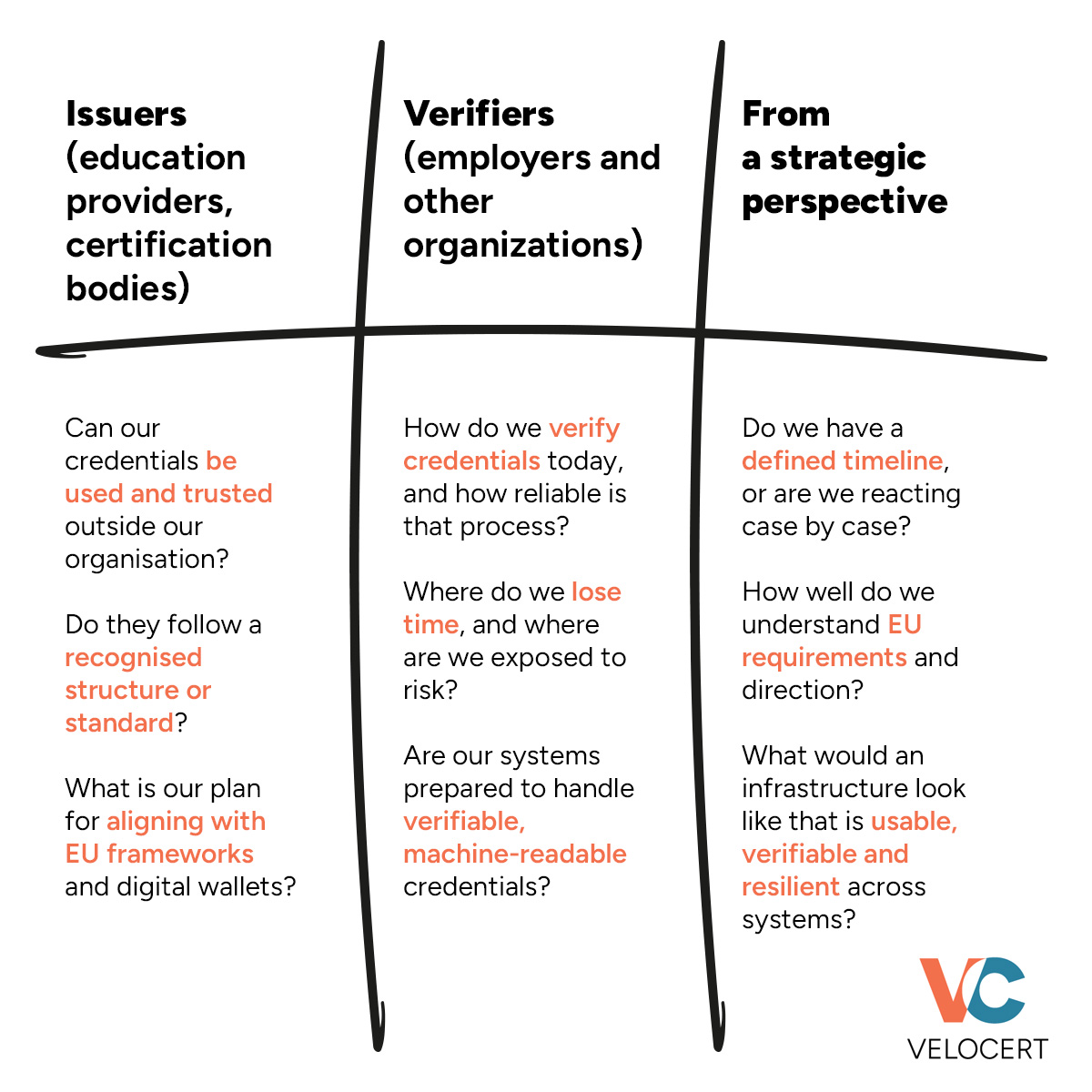
Timelines may differ, but the outcome is converging: credentials that can be trusted, verified and used anywhere.
What comes next
It is still possible to wait and observe. But this is no longer a space without direction. Standards are defined, and expectations are forming.
If you issue credentials, they will need to be usable beyond your own environment.
If you rely on credentials, manual verification will become increasingly inefficient and risky.
If you operate across borders, consistency and trust in data will become essential.
Micro-credentials and verifiable credentials are becoming part of how skills are exchanged across Europe. Not as an additional layer, but as a baseline.
At Velocert, we work with organisations at different stages. Some are already implementing. Others are mapping their next steps. Both are valid starting points.
What matters now is not whether this shift will happen, but how and when you start adapting your processes.
The infrastructure is ready. The next step is yours.
***
Ready to align your credentials with European standards?
Reach out to Velocert to assess your current setup or explore how to move forward.