Behind every European Digital Credential lies a sophisticated data architecture that’s revolutionising how we describe, understand, and validate learning across 27 countries. Meet the European Learning Model—the invisible foundation making seamless European education mobility possible.
When a Finnish engineering student transfers to a Portuguese university, how does the receiving institution understand exactly what a Diploma in Advanced Thermodynamics entails in the Finnish curriculum? How do they know it’s equivalent to their own course requirements for a diploma? The answer lies in a data model that’s transforming European education from the inside out.
This isn’t just another technical standard buried in European bureaucracy. The European Learning Model represents the culmination of years of development, building upon earlier versions to create the most ambitious unified language for learning that works across cultures, languages, and educational systems—and it’s changing how Europeans pursue education and careers.
The Babel Tower Problem in European Education
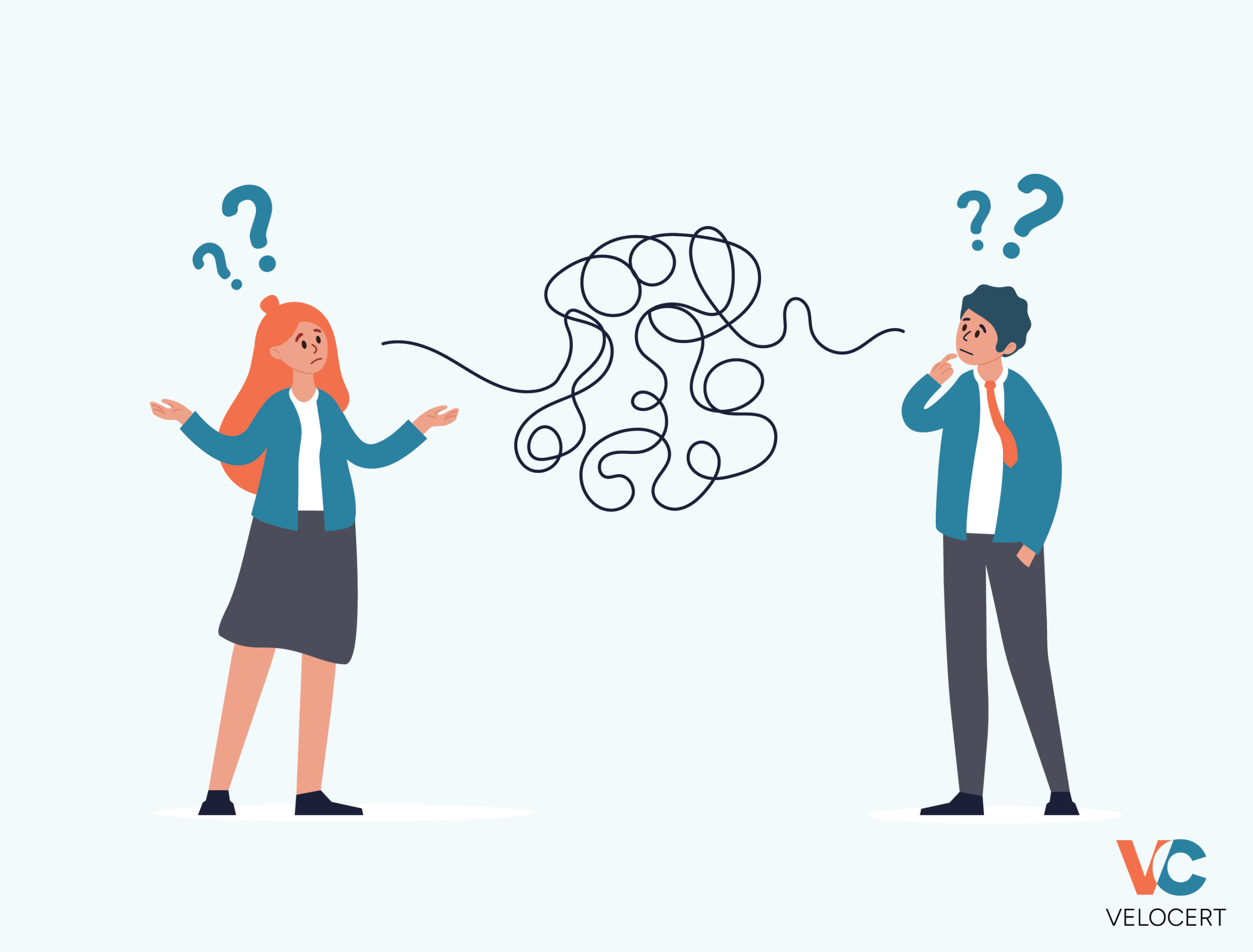
Before the launch of ELM version 3 in May 2023, European education resembled the biblical Tower of Babel. Whilst earlier versions of the European Learning Model had been developed for specific European Commission applications and pilot programmes, they remained fragmented across different use cases. Every country, institution, and sector continues to develop its own way of describing learning achievements, skills, and qualifications. Whether a “Master’s degree” in Germany carries different assumptions than one in Italy is not clear to the untrained eye.
This fragmentation creates invisible barriers to European mobility:
- Recognition Nightmares: Students or job seekers might be waiting for weeks or months on official translations of educational concepts between systems that simply don’t speak the same semantic language.
- Skills Mismatches: Employers struggle to understand what qualifications from other countries actually mean in practical terms, leading to underemployment of qualified European professionals.
- Administrative Complexity: Educational institutions maintain separate data systems for domestic and international partnerships, multiplying complexity and costs.
The European Learning Model (ELM) emerged as the European Union’s comprehensive solution to this linguistic and semantic chaos. Whilst previous versions had served specific purposes—supporting European Commission applications and pilot programmes in select member states—ELM version 3, launched in May 2023, represents the first unified model designed for all European education and employment stakeholders.❶
What Exactly Is the European Learning Model?
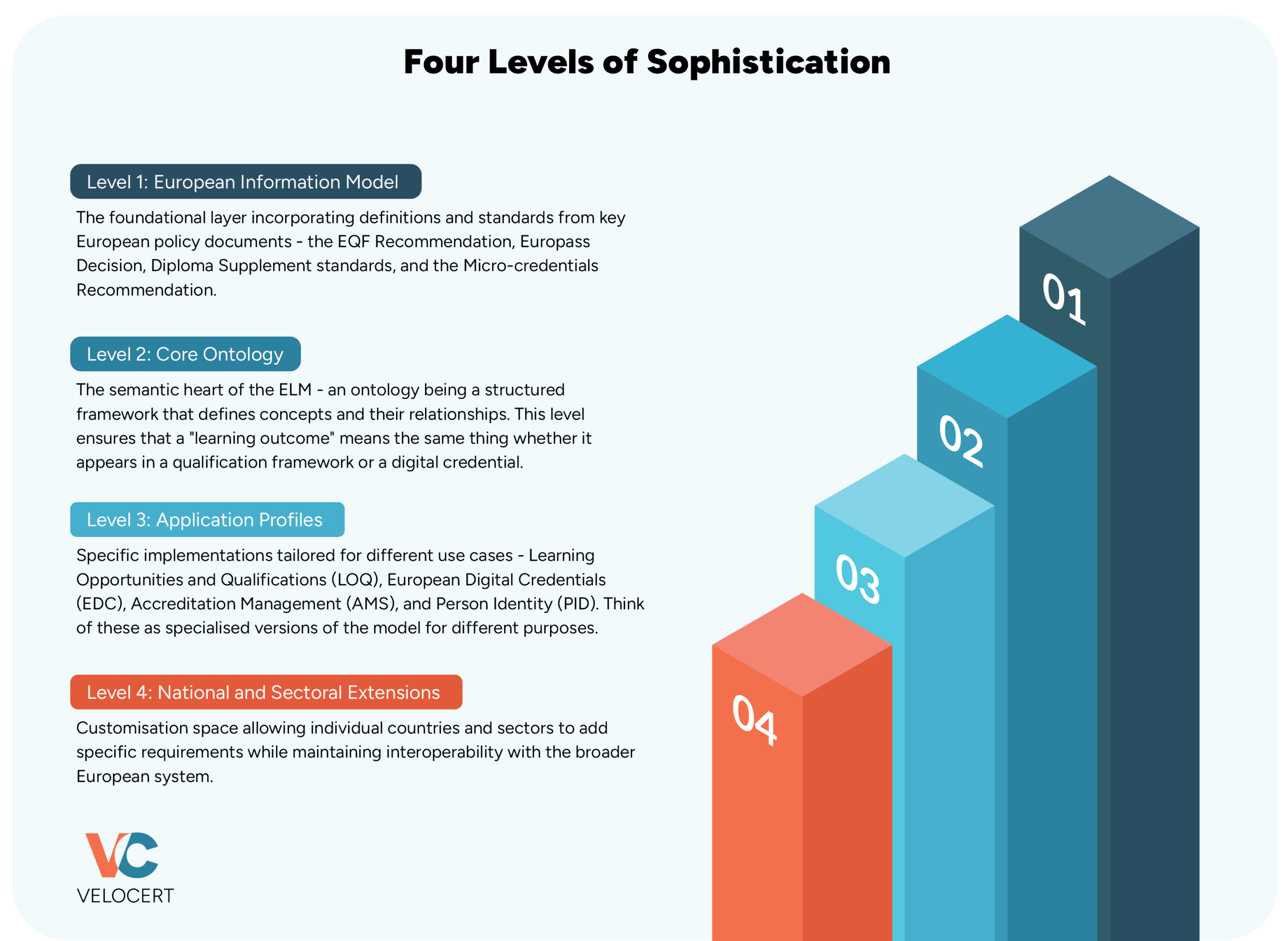
The ELM isn’t a simple database or filing system—it’s a semantic framework that provides the first unified vocabulary for describing learning across the entire European Education Area. Think of it as the DNA of European digital credentials, encoding everything from basic course information to complex competency relationships in a standardised, machine-readable format.
At its core, the ELM serves four fundamental functions:
- Semantic Standardisation: Every educational concept—from “learning outcome” to “assessment method”—has a precise, consistent definition across all European languages and contexts.
- Relationship Mapping: The model doesn’t just define individual concepts but explains how they relate to each other, creating rich knowledge graphs (visual networks that show connections between different pieces of information) that support advanced applications.
- Cultural Translation: Beyond literal language translation, the ELM bridges different educational cultures and traditions, making German apprenticeship models comprehensible in Greek universities.
- Future-Proofing: Built on W3C open standards (internationally agreed technical specifications), the ELM can evolve and extend to accommodate new educational innovations and technologies.
The Technical Architecture: 480+ Properties for Comprehensive Learning Description
The ELM works because of its detail and flexibility. With over 480 properties available for describing learning experiences, the model can capture everything from basic course titles to complex competency frameworks and assessment methodologies.❷ For those seeking to understand this complexity, the European Commission provides the ELM Browser—an interactive tool that allows users to explore all these properties in detail.❸
The Multilingual Breakthrough
Perhaps the ELM’s most remarkable achievement is its truly multilingual nature. Available in 30 languages, the model doesn’t just translate terms—it maintains semantic consistency across different educational cultures and traditions.❹
This multilingual capability enables:
- Automatic Translation: Digital credentials, for example, can be automatically presented in the reader’s preferred language without losing technical precision or educational meaning.
- Cultural Bridge-Building: Educational concepts that don’t exist in certain cultures can be explained and contextualised using the ELM’s rich relationship mapping.
- Cross-Border Collaboration: Institutions can collaborate on programmes and partnerships with confidence that their data will be accurately understood and processed.
Real-World Applications: The ELM in Action
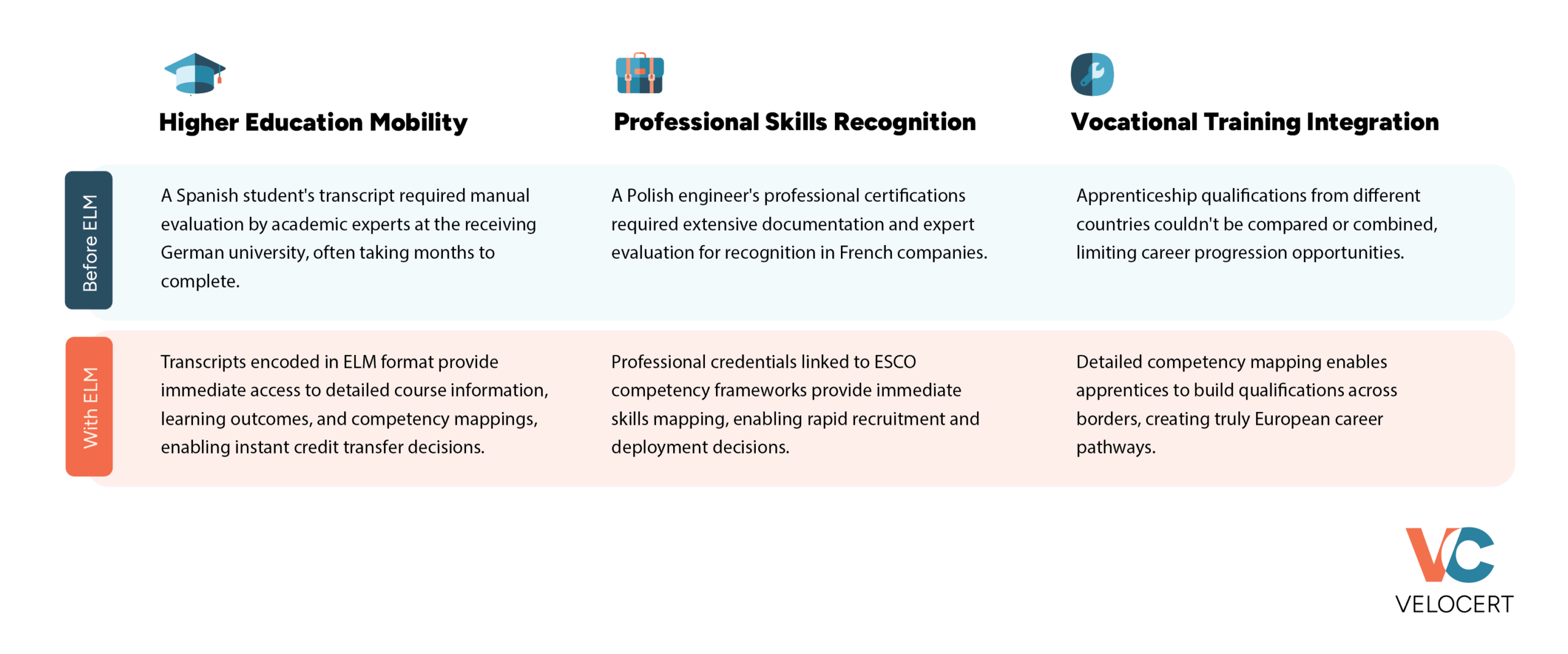
The ELM’s impact extends into practical applications transforming European education:
An Innovation Catalyst
The ELM’s structured data approach is supports innovation in educational technology:
- Skills Matching Algorithms: AI systems can automatically match learners with relevant opportunities by analysing detailed competency data stored in ELM format.
- Learning Pathway Optimisation: Machine learning algorithms could suggest optimal course sequences and career progressions based on comprehensive learning outcome data.
- Personalised Guidance: Career counselling systems provide more accurate advice by understanding the precise skills and competencies each credential represents.
The Strategic Imperative
The European Learning Model represents more than a technical standard; it’s the foundation for a truly integrated European Education Area where learning achievements are universally understood, instantly verified, and seamlessly portable across borders. The transition from earlier fragmented versions to the unified ELM v.3 marks a pivotal moment in European educational cooperation.
Ready to harness the power of the European Learning Model for your institution? Velocert uses the ELM as the backbone of its digital credentialing platform, helping institutions unlock the full potential of standardised learning data whilst ensuring seamless integration with existing systems and workflows.